
Every international sale raises the same questions. Who books and pays for the transport? Who is responsible if the goods are damaged on the way? Who clears customs and pays the duties? Incoterms answer all of them in three letters. This guide explains the 11 Incoterms 2020 rules in plain English, so you can pick the right one for your next shipment.
What are Incoterms?
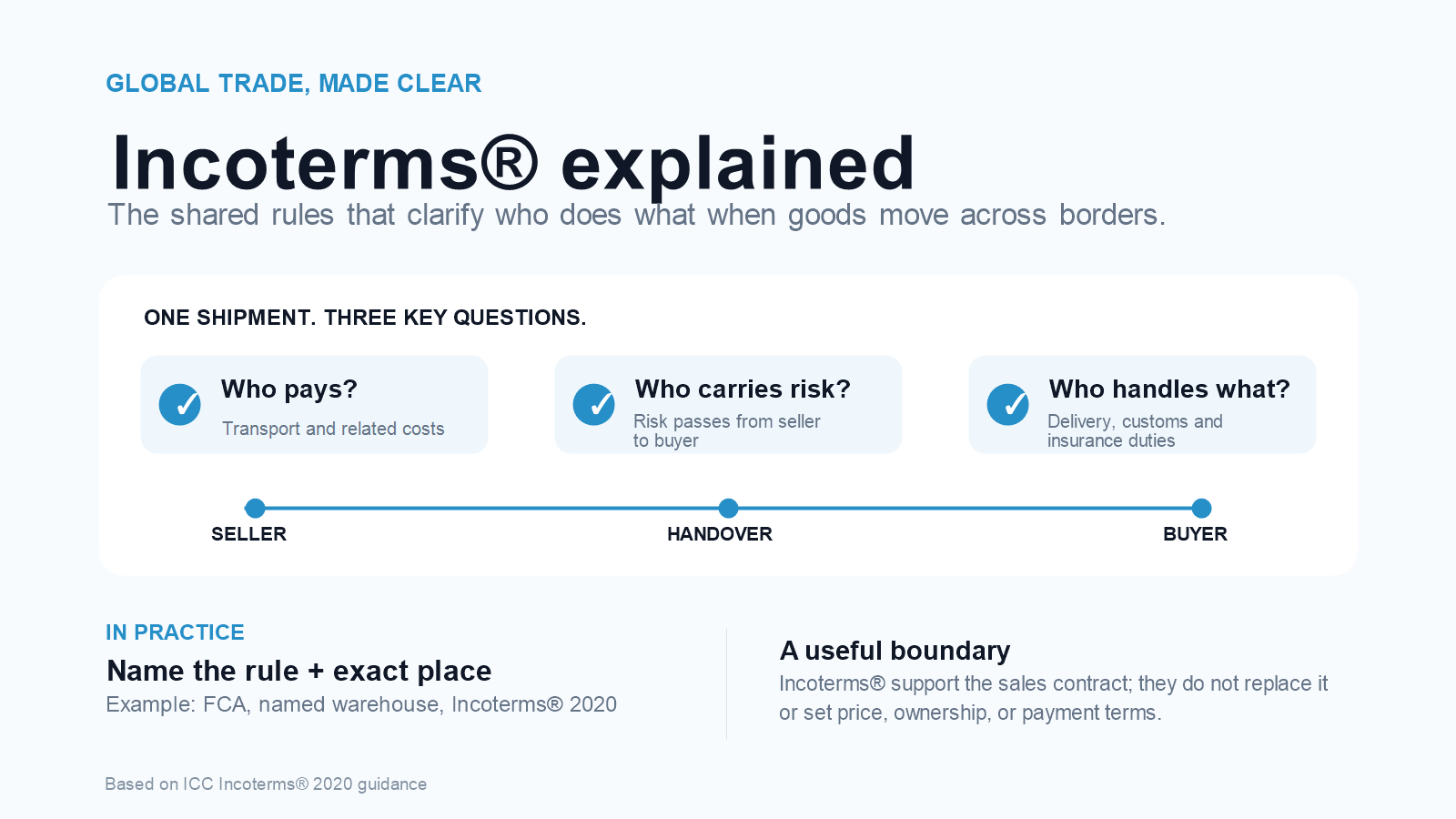
Incoterms are standard trade terms published by the International Chamber of Commerce (ICC). When a buyer and a seller put one in their contract, such as FOB or DAP, both sides know exactly who handles which costs, which risks and which paperwork.
Incoterms 2020 is the edition most contracts use today. They are not laws. They only apply if you write them into your contract, so always name the rule, the place and the edition, for example "DAP Rotterdam, Incoterms 2020".
What Incoterms decide
Every rule answers four questions:
- Delivery: where does the seller's job end?
- Risk: from which point does the buyer carry the risk of loss or damage?
- Costs: who pays for transport, insurance, export and import clearance?
- Paperwork: who arranges export and import documents?
What they do not decide: when the buyer owns the goods, when payment is due, or what happens if someone breaks the contract. Those go in your sales contract.
The two groups
The 11 rules fall into two groups.
- Rules for any mode of transport: EXW, FCA, CPT, CIP, DAP, DPU and DDP. Use these for air, road, rail, containers, or a mix.
- Rules for sea and inland waterway only: FAS, FOB, CFR and CIF. Use these only for bulk or break-bulk cargo moved by water.
The 7 rules for any mode of transport
- EXW (Ex Works): the seller makes the goods available at its own premises. The buyer does everything from there: loading, transport, export clearance and import clearance. This is the most buyer-heavy rule.
- FCA (Free Carrier): the seller hands the goods to the buyer's carrier at a named place and clears them for export. Risk passes at that handover. It is the usual choice for containers and air freight.
- CPT (Carriage Paid To): the seller pays for transport to a named destination. Risk passes to the buyer as soon as the goods are handed to the first carrier, even though the seller paid for the journey.
- CIP (Carriage and Insurance Paid To): the same as CPT, and the seller also buys insurance for the buyer. Under Incoterms 2020 the insurance must be wide cover (Institute Cargo Clauses A).
- DAP (Delivered at Place): the seller delivers the goods to the named destination, ready to unload. The seller carries the risk until then. The buyer unloads and clears import.
- DPU (Delivered at Place Unloaded): like DAP, but the seller also unloads at the destination. DPU replaced the older DAT rule in 2020.
- DDP (Delivered Duty Paid): the seller delivers to the buyer's door and pays import duties and taxes. This is the most seller-heavy rule and needs care, because the seller must handle import clearance in the buyer's country.
The 4 sea-only rules
- FAS (Free Alongside Ship): the seller places the goods next to the vessel at the port of shipment. The buyer takes over from there.
- FOB (Free on Board): the seller loads the goods on the vessel and clears export. Risk passes once they are on board.
- CFR (Cost and Freight): the seller pays for sea freight to the destination port. Risk passes when the goods are on board at the port of shipment.
- CIF (Cost, Insurance and Freight): the same as CFR, plus the seller buys minimum insurance for the buyer (Institute Cargo Clauses C).
Which one should you choose?
- Shipping in a container, by air or by truck: use FCA, CPT, CIP, DAP, DPU or DDP. The ICC advises the sea-only rules for non-container cargo.
- Want the buyer to handle everything: FCA is usually safer for the seller than EXW, because the seller keeps control of export clearance.
- Want to sell a delivered price: DAP is easier to manage than DDP, because the buyer pays import duties.
- Selling bulk cargo by sea: FOB, CFR and CIF are the classic choices.
- Unsure about import rules in the other country: avoid DDP unless your forwarder confirms it can handle them.
Common mistakes
- Using FOB or CIF for containers. The goods are handed over at a terminal before they are loaded on board, so FCA, CPT or CIP fit better.
- Writing only the three letters. Always add the named place and "Incoterms 2020".
- Assuming the seller's insurance covers everything. Even CIF and CIP give only a defined level of cover.
- Confusing who pays with who carries the risk. In CPT, CIP, CFR and CIF the seller pays for transport, but risk has already passed to the buyer.
- Choosing DDP without knowing the destination country's import VAT and duty rules.
Keep them one click away
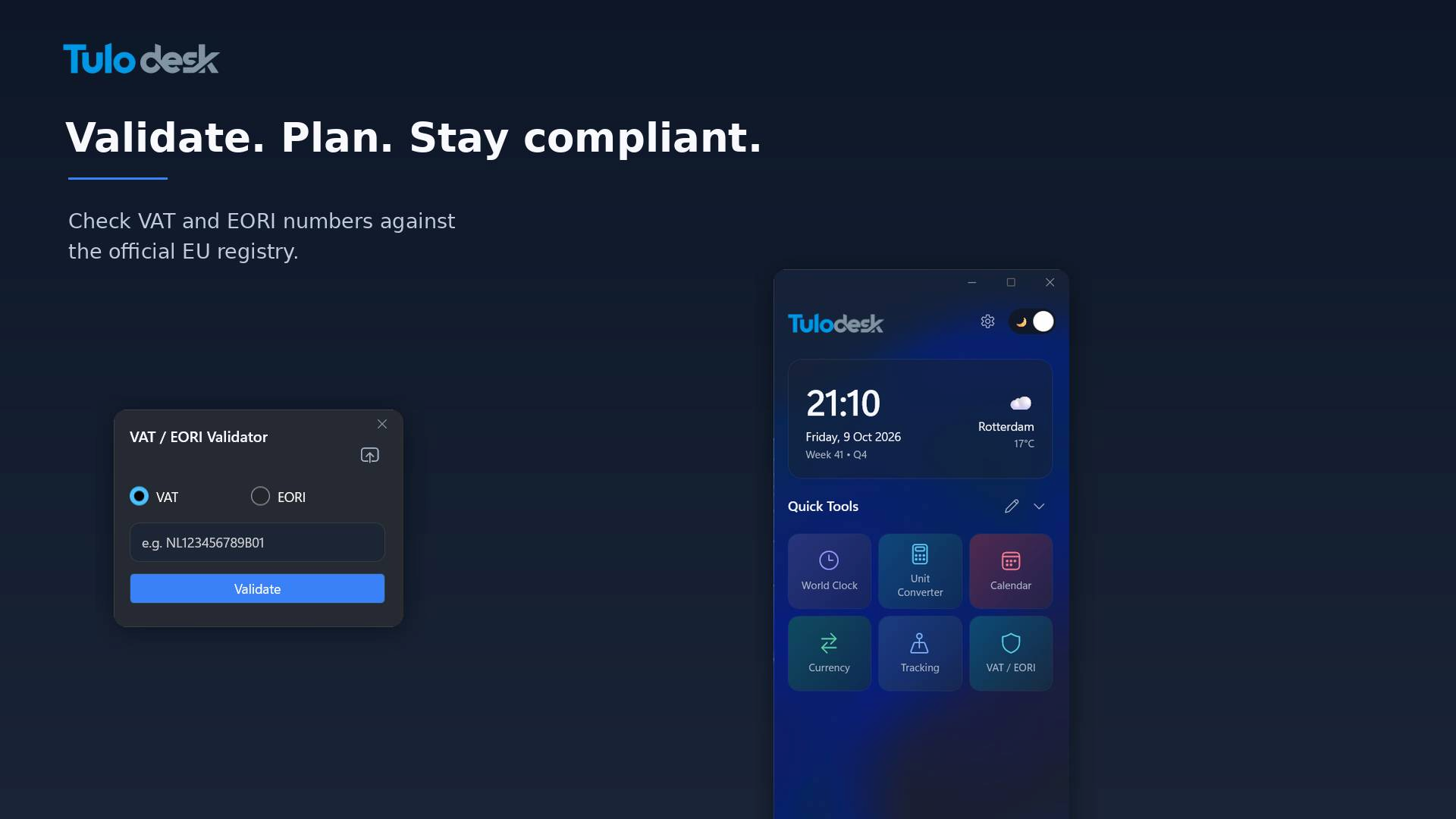
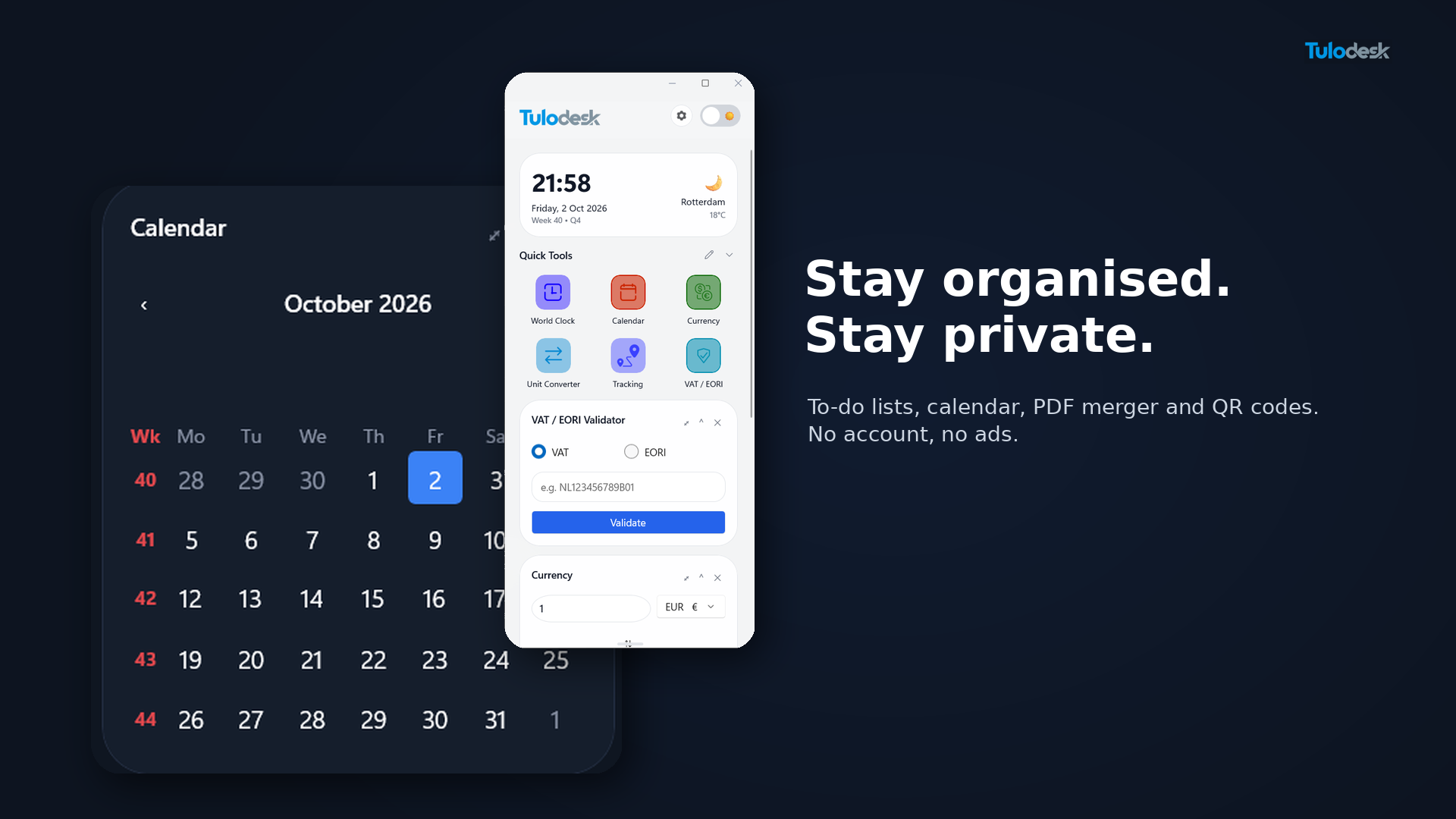
Customs forms, quotes and contracts all use these terms. The free TuloDesk Incoterms guide keeps the 11 rules, with summaries of who is responsible for what, always within reach. The same Windows widget also holds a VAT and EORI checker, an HS code lookup, a currency converter with ECB rates and more. For the customs side of a shipment, see our guides on how to check if a VAT number is valid and on HS codes.
This guide is a plain-English summary for quick reference, not legal advice and not the official ICC publication. Always confirm the exact terms in your contract.
Frequently asked questions
How many Incoterms are there?
Incoterms 2020 has 11 rules: seven for any mode of transport (EXW, FCA, CPT, CIP, DAP, DPU, DDP) and four for sea and inland waterway only (FAS, FOB, CFR, CIF).
What is the difference between FOB and CIF?
In both, risk passes when the goods are on board the ship at the port of shipment. With FOB the buyer arranges and pays the sea freight and insurance. With CIF the seller pays for the sea freight and for minimum insurance.
Which Incoterm is best for containers?
The sea-only rules do not suit containers well, because the goods are handed over at a terminal before loading. FCA, CPT, CIP or DAP are the usual choices.
What is the difference between DAP and DDP?
With DAP the seller delivers to the named place, and the buyer clears import and pays duties and taxes. With DDP the seller also clears import and pays the duties and taxes, so it carries the most responsibility.
Are Incoterms legally binding?
Only if you include them in your contract. Name the rule, the place and the edition, for example "FCA Hamburg, Incoterms 2020".